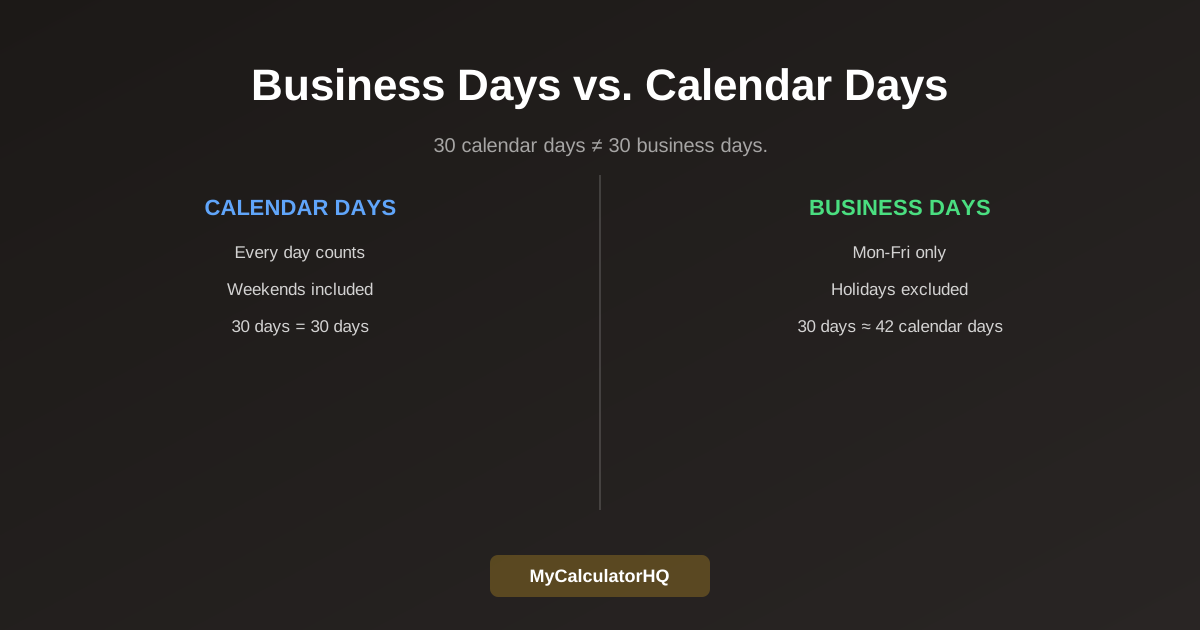
Your contract says payment is due "within 30 days." Your loan agreement says "30 business days." Your legal filing deadline is "21 calendar days." These are all different.
Understanding the distinction between business days and calendar days — and how to calculate each — prevents missed deadlines.
Calendar Days
Calendar days are simple: every day counts, including weekends and holidays. January 1 to January 31 is always 30 calendar days.
When a contract says "30 days" without qualification, it typically means calendar days.
Business Days
Business days exclude weekends (Saturday and Sunday). Some definitions also exclude public holidays.
30 business days ≈ 6 calendar weeks (assuming no holidays).
More precisely: 30 business days = 30 weekdays = 6 weeks of Monday-Friday.
But holidays complicate this. If there are 3 holidays in those 6 weeks, you need 6 weeks + 3 extra days to get 30 business days.
Conversion: Calendar Days to Business Days
Approximate rule: multiply calendar days by 5/7 to get business days.
30 calendar days × (5/7) ≈ 21-22 business days
Or the reverse: multiply business days by 7/5 to get approximate calendar days.
30 business days × (7/5) = 42 calendar days
These are approximations — exact counts depend on which specific days of the week the period starts and ends on, and which holidays fall within it.
Common Contexts Where It Matters
Payments and invoices: "Net 30" in business typically means 30 calendar days. Some industries use "30 business days" — always clarify.
Legal filings: Court rules specify calendar days or business days precisely. Missing a deadline because you miscounted can have serious consequences — always use calendar days for legal matters unless specifically stated otherwise.
Shipping: "5-7 business days" is a common shipping estimate. A package ordered on Friday might not ship until Monday, adding 2 calendar days before the clock starts.
Employment notice periods: "Two weeks notice" means 14 calendar days at most employers, but some contracts specify business days.
Holidays: The Variable
Public holidays vary significantly:
- US federal holidays: 11 per year
- UK bank holidays: 8 per year in England/Wales
- Some industries have additional closures
- Some companies observe floating holidays
For precise business day calculations involving a specific institution, you need to know their specific holiday calendar.
Calculate business days or calendar days between any two dates with our Date Difference Calculator.
Common Questions
Frequently Asked Questions
Calculators Mentioned in This Article
Related Articles
Age Difference Between Two People: How to Calculate It Accurately
How Long Ago Was It? Calculating Time Elapsed Since Any Past Date
How Many Days Until: Calculating Countdown to Any Future Date
Get calculator tips
Weekly guides. No spam. Free forever.
You're in! Check your inbox.