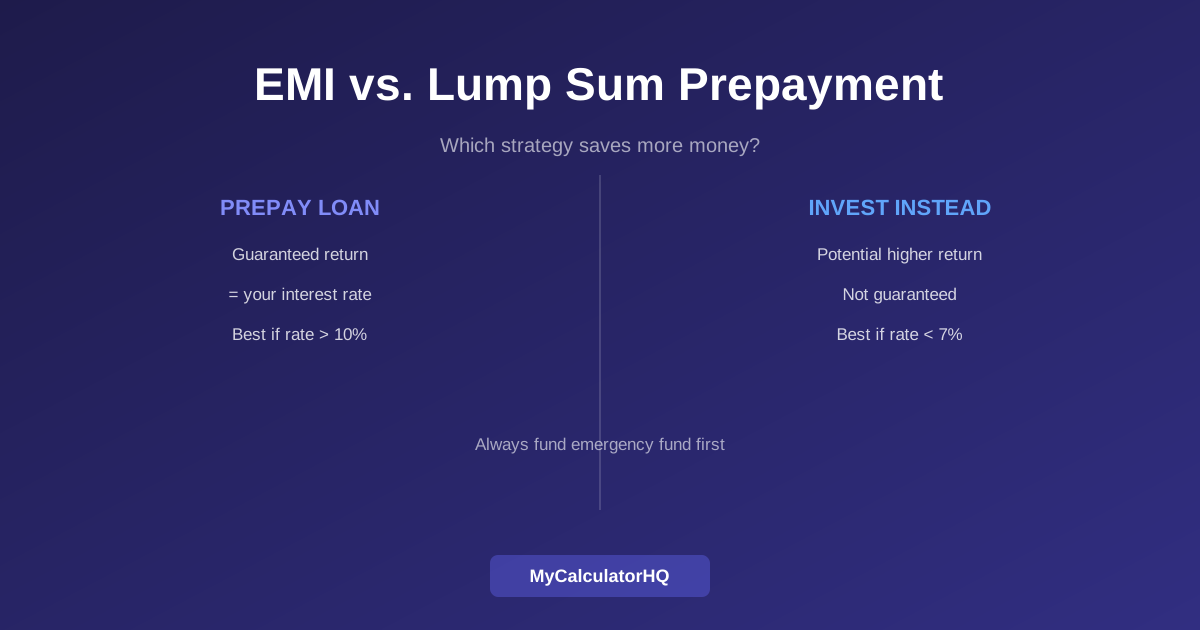
You have a loan with a fixed EMI. You also have some extra money — maybe from a bonus, a tax refund, or just disciplined saving. Should you make a lump sum payment against your loan, or invest the money instead?
This is one of the most common personal finance dilemmas — and the answer isn't always obvious.
The Pure Math: When Prepayment Wins
Paying extra toward your loan principal saves you the loan's interest rate on that money — guaranteed.
If your loan is at 12% interest, every $1,000 you prepay saves you $120/year in interest. That's a guaranteed 12% return.
Compare this to investing:
- High-yield savings account: ~4.5% — loan prepayment wins
- Government bonds: ~5% — loan prepayment wins
- Stock market (historical average): ~10% — close, depends on your risk tolerance
- Stock market (expected next 5 years): uncertain — prepayment offers certainty
The break-even point: if your loan interest rate is lower than your expected investment return, invest. If it's higher, prepay.
A Real Comparison
Scenario: $30,000 loan at 11% for 5 years. You have $5,000 extra.
Option A: Prepay $5,000 now (reduce EMI)
- New principal: $25,000
- New EMI: ~$543 (down from $652)
- Total interest saved: ~$1,850
- Guaranteed return: 11%
Option B: Invest $5,000 in index fund
- Continue paying $652/month EMI
- $5,000 invested at 10% average return for 5 years = ~$8,053
- Profit: $3,053
- But this is not guaranteed — markets could return 5% or 15%
The investment wins slightly in the best case but carries risk. Prepayment provides certainty.
The Hybrid Strategy
Most financial advisors suggest a middle path:
- Maintain 3–6 months emergency fund first
- Capture any employer retirement match (it's a 100% instant return)
- Pay off high-interest debt (credit cards above 15%)
- Then split remaining extra money: some to loan prepayment, some to investing
This approach hedges between guaranteed debt reduction and potential investment upside.
When Lump Sum Prepayment Clearly Makes Sense
- Your loan rate is above 10–12%
- You have no high-return investment opportunities
- The psychological relief of being debt-free is valuable to you
- You're approaching retirement and can't afford investment volatility
- Your emergency fund is already fully funded
When Investing Might Make More Sense
- Your loan rate is below 7–8%
- You have a long investment horizon (20+ years)
- You have tax-advantaged investment space available (Roth IRA, 401k)
- Your financial situation is stable and emergency fund is solid
Model how lump sum payments affect your remaining EMIs with our EMI Calculator.
Common Questions
Frequently Asked Questions
Calculators Mentioned in This Article
Related Articles

How to Pay Off Your Mortgage Faster — 5 Strategies That Actually Work

Personal Loan vs. Credit Card: Which One Should You Use?

Fixed vs. Adjustable Rate Mortgage: Which One Is Right for You?
Get calculator tips
Weekly guides. No spam. Free forever.
You're in! Check your inbox.