"Avoid all debt" sounds like solid financial advice. But follow it too strictly and you might miss out on opportunities that could genuinely improve your life and finances.
The real skill isn't avoiding debt entirely — it's knowing which debt to take and which to avoid.
What Makes Debt "Good" or "Bad"?
The distinction isn't really about the type of loan. It's about what the borrowed money does for you.
Good debt characteristics:
- Used to acquire an asset that appreciates or generates income
- Interest rate is relatively low
- Manageable payment relative to income
- Has a clear payoff timeline
Bad debt characteristics:
- Used for consumption (things you use up)
- High interest rate
- Payment feels like a stretch
- Easy to keep rolling over indefinitely
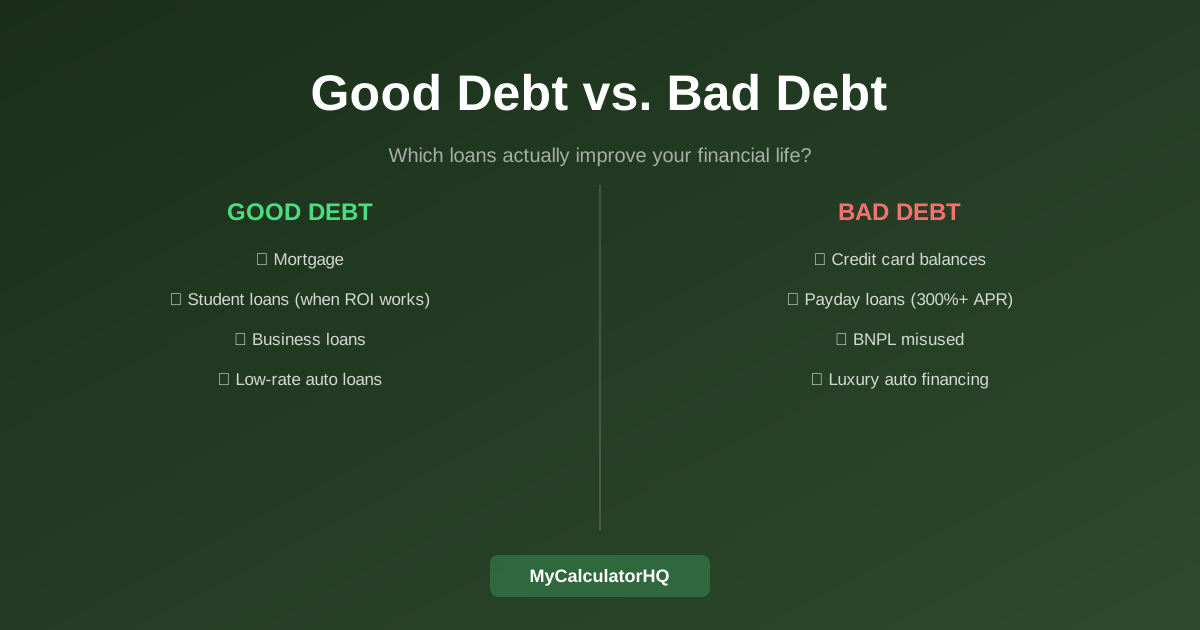
Examples of Generally Good Debt
Mortgage (Home Loan)
Real estate has historically appreciated over time. A mortgage lets you own an appreciating asset while building equity with each payment. You also get a place to live — which you'd otherwise pay rent for anyway.
Key conditions that make a mortgage genuinely good debt: affordable payment (under 28–30% of gross income), reasonable down payment, and a home in a stable or growing market.
Student Loans — Sometimes
Student loans are good debt if the degree leads to income that significantly exceeds what you could earn without it, and if the loan amount is proportional to that income.
A useful rule of thumb: total student loan debt shouldn't exceed your expected starting annual salary. If you borrow $80,000 for a degree that leads to a $40,000/year job, the math doesn't work.
Student loans are bad debt when the degree has weak income prospects and the debt load is high.
Business Loans
Borrowing to start or grow a business that generates more income than the loan costs is classic good debt. A $50,000 business loan at 8% costs about $4,000/year in interest. If the business generates $20,000+ in additional annual profit, the loan pays for itself many times over.
The risk: businesses fail. Borrowed money doesn't disappear when a business does.
Auto Loans — Conditionally
Cars depreciate. That makes auto loans closer to bad debt by the strict definition. But a car loan at a low rate (under 6–7%) for a reliable vehicle that enables you to earn income is defensible — especially when you don't have cash to buy outright.
What makes it bad debt: financing a luxury vehicle you don't need, rolling negative equity into a new loan, or taking a long-term loan (72–84 months) just to afford the payment.
Examples of Generally Bad Debt
Credit Card Balances
Average credit card interest rates have exceeded 20% in recent years. Carrying a $5,000 balance at 22% costs $1,100/year in interest — for money you've already spent. There is almost no financial scenario where this makes sense.
Credit cards themselves aren't bad — used and paid off monthly, they offer rewards and protection. The balance is the problem.
Payday Loans
Payday loans are among the most expensive financial products legally available. Typical APRs range from 300% to 400%. A $300 payday loan for two weeks might cost $45 in fees — that's 391% APR. These should be avoided in virtually all circumstances.
Buy Now, Pay Later (BNPL) — Sometimes
BNPL services like Afterpay and Klarna offer 0% interest — if paid on time. The problem: they make purchases feel more affordable than they are, often leading people to buy things they wouldn't otherwise buy. And late fees can be significant.
For a purchase you were going to make anyway and can definitely pay off on schedule, BNPL can be useful. As a way to buy things you can't afford, it's a trap.
The Interest Rate Rule of Thumb
A simple framework: compare your loan's interest rate to what that money could earn invested.
Long-term stock market average: approximately 7–10% annually.
- Debt under 5–6%: Often worth carrying while keeping money invested
- Debt at 6–10%: Gray area — pay down aggressively
- Debt above 10%: Pay off before investing; guaranteed return exceeds likely investment return
This is why high-interest credit card debt should always take priority over retirement contributions (beyond any employer match).
The Real Test
Before taking any loan, ask: Will this loan improve my financial position over time, or just let me spend money I don't have?
If it's the former, the debt might be worth taking. If it's the latter, find a different path.
Calculate exactly what any loan will cost you over time with our Loan Calculator before committing.
Common Questions
Frequently Asked Questions
Calculators Mentioned in This Article
Related Articles

How to Pay Off Your Mortgage Faster — 5 Strategies That Actually Work

Personal Loan vs. Credit Card: Which One Should You Use?

Fixed vs. Adjustable Rate Mortgage: Which One Is Right for You?
Get calculator tips
Weekly guides. No spam. Free forever.
You're in! Check your inbox.