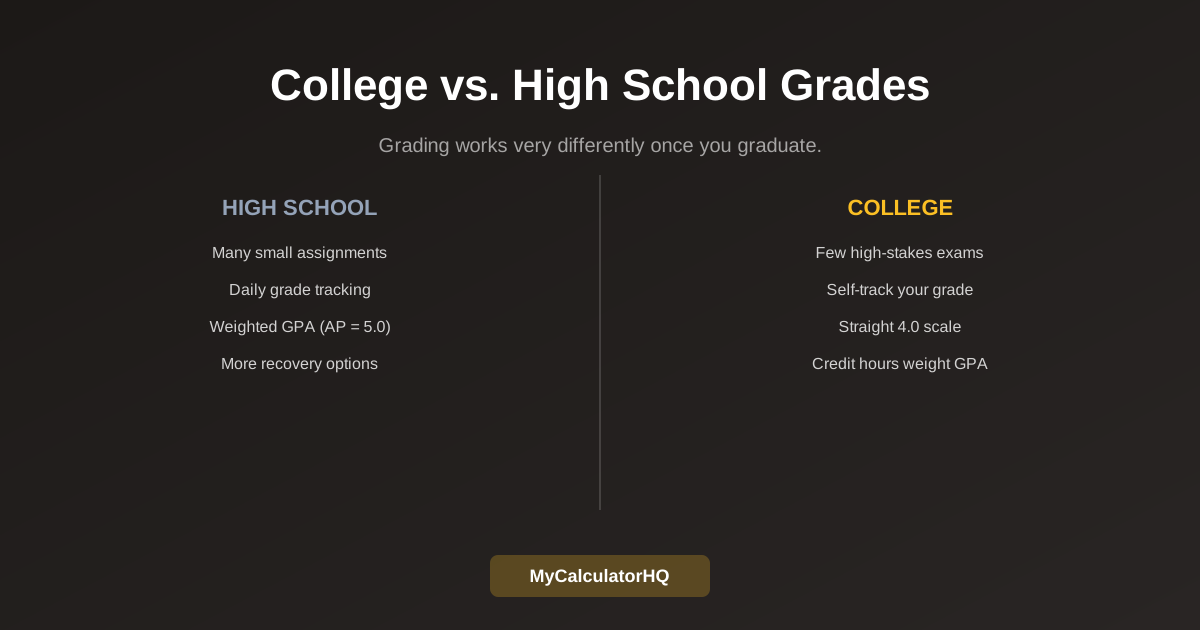
High school seniors heading to college are often surprised that grades don't work the same way. The calculation methods, the grading curves, the weight of individual assignments — everything is different.
Here's what changes and what stays the same.
High School Grading: How It Typically Works
High school grading tends to be more structured and standardized:
- Grades are often tracked daily — homework, participation, classwork all count
- Many small assignments average out over time
- Teachers often round grades at the border
- Some schools use 10-point letter grade bands (90-100 = A, 80-89 = B)
- Grade recovery options are more commonly available
- Parents often have access to grade portals and can monitor progress
High school GPA uses the same 4.0 scale but often includes weighted grades for AP/IB/Honors courses (A in AP = 5.0 in many systems).
College Grading: What Changes
Fewer, higher-stakes assessments: A typical college course might have 2-3 exams and a final — each worth 25-35%. One bad exam can significantly damage your grade. There are fewer low-stakes assignments to cushion the impact.
More precise percentage cutoffs: An 89.4% is a B+ — professors rarely round up without a specific rounding policy. If the syllabus says 90% = A-, then 89.9% = B+.
Less hand-holding: Professors don't remind you of assignments, accept late work as readily, or offer the same recovery opportunities. Responsibility for grade tracking falls on you.
Credit hours matter: In college, a 4-credit course affects your GPA four times more than a 1-credit course. In high school, all classes typically count equally.
No weighted GPA in college: College uses a straight 4.0 scale. An A in a 1-credit gym class and an A in a 4-credit organic chemistry course both give 4.0 grade points — but the chemistry course contributes 4x more to your GPA.
Curves and Grade Adjustments
High school: Curves are common and often generous. A class average of 65% might get curved to 75%.
College: Curves vary widely by professor and discipline. Some never curve. Some curve to a specific class average. Some use absolute grading (a 90% is always an A regardless of class performance). Ask your professor about their policy early in the semester.
The Biggest Adjustment: Self-Tracking
In high school, your grade is usually visible in a parent/student portal that updates frequently. In college:
- Some professors don't post grades until the end of the semester
- You may need to calculate your own running grade
- Office hours are your primary resource for understanding your standing
The students who succeed in college grades are those who actively track their standing — not those who wait to see what shows up at the end.
Track your grades in any course structure with our Grade Calculator.
Common Questions
Frequently Asked Questions
Calculators Mentioned in This Article
Related Articles
How to Calculate Your GPA: Step-by-Step Guide for High School and College

Weighted vs. Unweighted GPA: What's the Difference and Which Matters More?

How to Raise Your GPA: A Realistic Plan That Actually Works
Get calculator tips
Weekly guides. No spam. Free forever.
You're in! Check your inbox.