You've seen "2,000 calories" on every nutrition label your entire life. That number comes from an FDA reference point — a rough average for adults. It doesn't reflect your body, your activity level, or your goals.
Your actual daily calorie needs could be anywhere from 1,600 to 3,500+ calories. Here's how to find your real number.
The Two Numbers You Need to Know
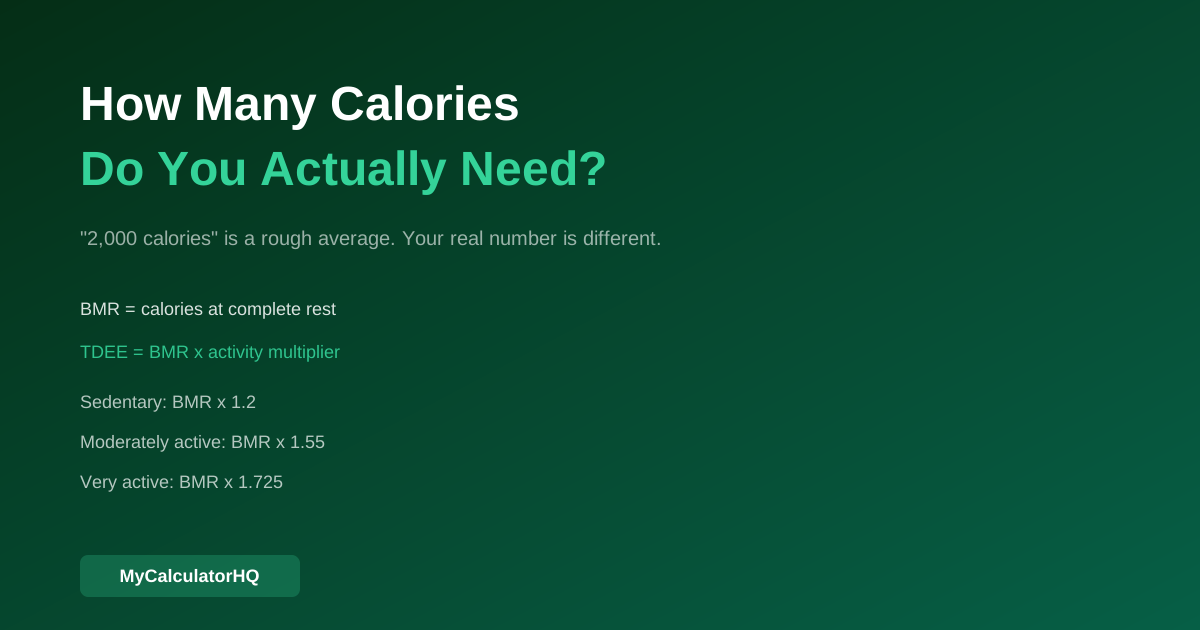
BMR (Basal Metabolic Rate): Calories your body burns at complete rest — just to keep you alive. Breathing, circulation, cell maintenance.
TDEE (Total Daily Energy Expenditure): Your actual daily calorie burn including activity. This is the number that matters for managing weight.
Calculating Your BMR
The most widely used formula is the Mifflin-St Jeor equation:
For men: BMR = (10 × weight in kg) + (6.25 × height in cm) - (5 × age) + 5
For women: BMR = (10 × weight in kg) + (6.25 × height in cm) - (5 × age) - 161
Example — 30-year-old woman, 65kg, 165cm:
BMR = (10 × 65) + (6.25 × 165) - (5 × 30) - 161
BMR = 650 + 1,031.25 - 150 - 161 = 1,370 calories/day
This is her calorie burn while doing absolutely nothing. If she ate exactly 1,370 calories and stayed in bed all day, she'd maintain her weight.
Calculating Your TDEE
Multiply your BMR by an activity multiplier:
| Activity Level | Description | Multiplier |
|---|---|---|
| Sedentary | Desk job, little exercise | × 1.2 |
| Lightly active | Light exercise 1–3 days/week | × 1.375 |
| Moderately active | Moderate exercise 3–5 days/week | × 1.55 |
| Very active | Hard exercise 6–7 days/week | × 1.725 |
| Extremely active | Physical job + hard daily exercise | × 1.9 |
Our example woman with a moderately active lifestyle:
TDEE = 1,370 × 1.55 = 2,124 calories/day
This is her maintenance level — eating 2,124 calories keeps her at the same weight.
Adjusting for Your Goal
To lose weight: Eat 300–500 calories below TDEE. A 500-calorie daily deficit creates approximately 1 pound of fat loss per week.
To gain weight/muscle: Eat 300–500 calories above TDEE. Excess calories support muscle growth when combined with resistance training.
To maintain: Eat at TDEE.
For our example: if she wants to lose weight, her target is 1,624–1,824 calories/day.
Why Your Calorie Needs Change Over Time
TDEE isn't fixed. Several factors change it:
- Weight loss: As you lose weight, your BMR decreases — you need fewer calories to maintain the lighter body. This is why weight loss often plateaus.
- Age: Metabolism slows gradually with age, roughly 2–3% per decade after 20.
- Muscle mass: More muscle = higher BMR. Resistance training increases your resting calorie burn.
- Activity changes: A new job, injury, or change in exercise routine shifts your TDEE.
Recalculate every 10–15 pounds of weight change or whenever your activity level changes significantly.
The Accuracy Problem
TDEE calculators give estimates — typically within 10–15% of actual needs. Individual variation is real: two people with identical stats can have meaningfully different metabolisms.
The most accurate method: track your actual food intake and weight for 2–3 weeks. If your weight is stable, your average daily intake is your true TDEE. Adjust from there.
Calculate your personalized daily calorie needs with our Calorie Calculator.
Common Questions
Frequently Asked Questions
Calculators Mentioned in This Article
Related Articles

BMI Calculator for Men vs. Women: Why the Same Number Means Different Things

How to Lower Your BMI: What Actually Works (And What Doesn't)

BMI by Age: How the Healthy Range Changes as You Get Older
Get calculator tips
Weekly guides. No spam. Free forever.
You're in! Check your inbox.