You need $10,000. A lender offers you a loan at 12% interest. Simple enough — you'll pay back $10,000 plus 12%, which is $1,200, right?
Not quite. And the gap between what most people assume and what they actually pay can be significant.
Here's how loan interest actually works — and what to look for before you sign anything.
Simple Interest vs. Compound Interest on Loans
Most personal loans use simple interest — calculated only on the principal (the amount you borrowed), not on accumulated interest.
But "simple" doesn't mean cheap. Here's why.
On a simple interest loan, your interest for any given period is:
Interest = Principal × Rate × Time
On a $10,000 loan at 12% annual interest for 3 years:
Total interest = $10,000 × 0.12 × 3 = $3,600
Total repayment = $13,600
Monthly payment = $13,600 ÷ 36 = $377.78
But wait — that assumes you still owe the full $10,000 the entire time. In reality, each payment reduces the principal, which means you owe less each month. The actual interest should be calculated on the declining balance.
Amortized Loans: What Actually Happens
Most personal loans are amortized — meaning each payment covers both interest and principal, with the balance recalculated monthly.
On a $10,000 loan at 12% annual interest (1% per month) for 36 months:
- Month 1: Interest = $10,000 × 1% = $100. If payment is $332, then $232 goes to principal.
- Month 2: Interest = $9,768 × 1% = $97.68. $234.32 goes to principal.
- This continues — interest portion shrinks, principal portion grows.
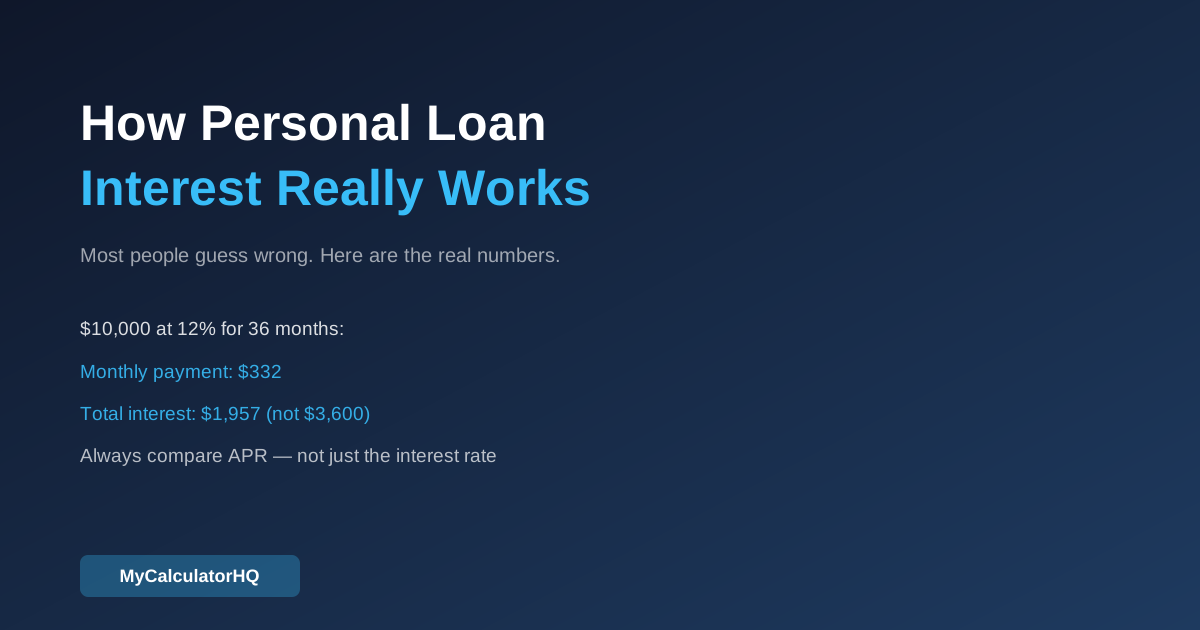
Total interest paid on this amortized loan: approximately $1,957 — not $3,600.
The monthly payment on an amortized $10,000 loan at 12% for 36 months is $332.14.
APR vs. Interest Rate: The Number That Actually Matters
Lenders advertise interest rates. What you should compare is APR — Annual Percentage Rate.
APR includes:
- The interest rate
- Origination fees (typically 1–8% of the loan amount)
- Any other mandatory charges
Example: A $10,000 loan at 10% interest with a 3% origination fee ($300) has an APR higher than 10% — because you received $9,700 but are paying interest on $10,000.
Two loans with the same interest rate but different fees will have different APRs. Always compare APR, not just the stated interest rate.
How Loan Term Affects Total Cost
Longer loan terms mean lower monthly payments but much higher total interest. This is one of the most counterintuitive aspects of borrowing.
Same $10,000 at 12% APR, different terms:
| Term | Monthly Payment | Total Interest | Total Paid |
|---|---|---|---|
| 12 months | $888 | $662 | $10,662 |
| 24 months | $470 | $1,289 | $11,289 |
| 36 months | $332 | $1,957 | $11,957 |
| 48 months | $263 | $2,638 | $12,638 |
| 60 months | $222 | $3,347 | $13,347 |
Choosing a 60-month term instead of 24 months saves $248/month — but costs an extra $2,058 in interest over the life of the loan.
The right choice depends on your cash flow. But go in knowing the trade-off.
Fixed vs. Variable Rate Loans
Fixed rate: Your interest rate stays the same for the entire loan. Your payment is predictable. Most personal loans are fixed rate.
Variable rate: Your interest rate fluctuates with a market index (usually the prime rate or SOFR). Your payment can go up or down. Variable rates often start lower but carry risk.
For short-term loans (under 3 years), variable rates are usually fine — there's limited time for rates to rise significantly. For longer loans, fixed rate provides more protection.
Prepayment: When Paying Early Saves Money
On simple interest amortized loans, paying extra toward principal reduces future interest charges. Every extra dollar you pay reduces the balance on which interest is calculated.
On that $10,000, 36-month, 12% loan: if you pay an extra $100/month starting from month 1, you pay off the loan in about 26 months and save approximately $430 in interest.
Important caveat: check for prepayment penalties before paying early. Some lenders charge a fee (often 1–2% of remaining balance) for paying off loans ahead of schedule. If the penalty exceeds your interest savings, it's not worth it.
What to Check Before Taking Any Loan
- APR (not just interest rate)
- Total repayment amount (not just monthly payment)
- Origination fees and when they're charged
- Prepayment penalties
- Late payment fees
- Whether the rate is fixed or variable
A loan calculator shows you items 1 and 2 instantly. Items 3–6 require reading the loan agreement.
See exactly what any loan will cost you with our Loan Calculator — enter the amount, rate, and term to get your full repayment picture.
Common Questions
Frequently Asked Questions
Calculators Mentioned in This Article
Related Articles

How to Pay Off Your Mortgage Faster — 5 Strategies That Actually Work

Personal Loan vs. Credit Card: Which One Should You Use?

Fixed vs. Adjustable Rate Mortgage: Which One Is Right for You?
Get calculator tips
Weekly guides. No spam. Free forever.
You're in! Check your inbox.