The SAT prep industry generates billions of dollars annually. Courses, tutors, books, apps — all promising to boost your score by hundreds of points.
The reality is more nuanced. Score improvements are real but vary enormously by student. Here's what research and evidence actually suggest about effective SAT prep.
Realistic Score Improvement Expectations
The College Board's own research suggests that most students improve 10–20 points on a retake without any prep. Dedicated prep can yield more — but results vary widely.
Typical improvements with serious prep:
- Very low initial score (below 900): 100–200 point improvement possible
- Middle range (1000–1200): 80–150 point improvement typical
- High initial score (1300+): 50–100 point improvement, harder to move
- Near-perfect (1500+): 10–50 point improvement, ceiling effect
The lower your starting score, the more room for improvement — and the more effective targeted prep tends to be.
What Actually Works: Evidence-Based Approaches
1. Official practice tests first
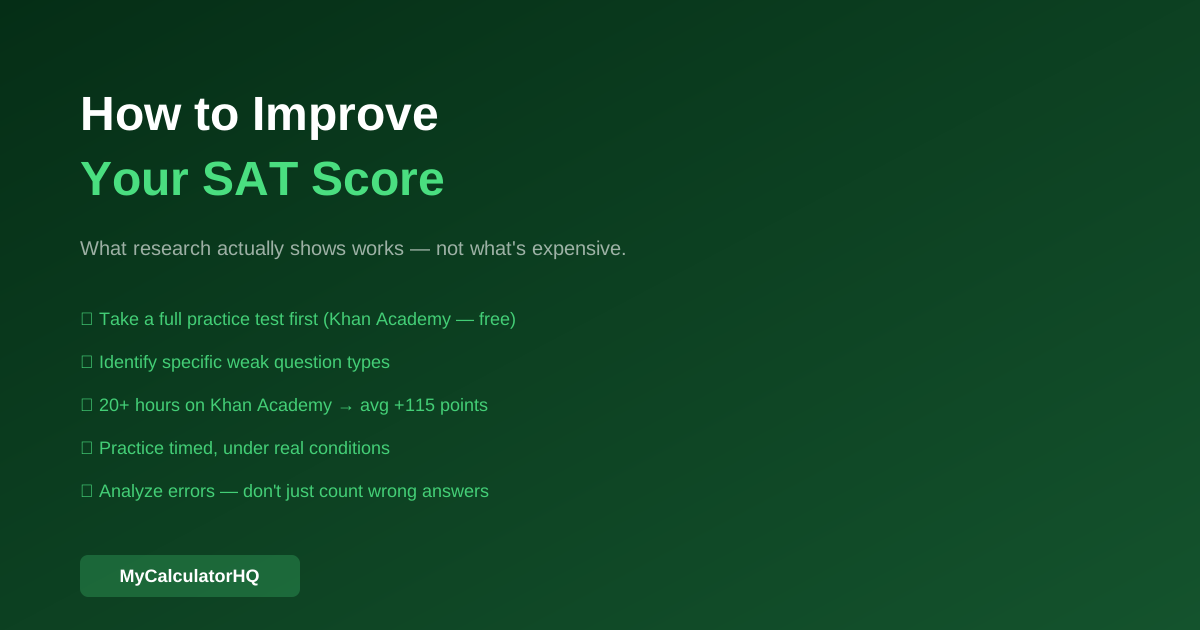
The College Board and Khan Academy offer free official SAT practice. Taking a full timed practice test is the most important first step — it shows you exactly where you are and where your weakest areas are. Many students skip this and waste time studying topics they already know.
2. Targeted weakness improvement
After your diagnostic test, identify the specific question types you miss most often. Focus prep time there. If you miss 8 Heart of Algebra questions but only 2 Passport to Advanced Math questions, study algebra — not both equally.
3. Khan Academy + College Board partnership
The free Official SAT Practice on Khan Academy is genuinely excellent. It adapts to your weaknesses based on your scores and provides targeted practice. Research showed students who used it for 20+ hours improved an average of 115 points. This is free and very effective.
4. Timed practice under real conditions
The digital SAT is adaptive and timed. Practice under actual test conditions — no breaks not allowed, timed sections, no phone. Untimed practice doesn't prepare you for the real experience.
5. Error analysis, not just practice volume
After each practice test, don't just check your score. Analyze every wrong answer: Why did you get it wrong? Was it a knowledge gap, a careless error, or a timing issue? Different diagnoses require different solutions.
What Doesn't Work (Or Is Overpriced)
Expensive test prep courses: Research shows expensive prep courses (often $1,000–$3,000+) don't significantly outperform free resources for most students. The main benefit is structure and accountability — which you can create for free.
Generic vocabulary lists: The SAT tests words in context, not isolated definitions. Memorizing 500 vocabulary words is a poor use of prep time compared to reading practice.
Starting too late: Two weeks of intensive prep before the test is less effective than three months of consistent, moderate practice. Start early.
The Timing Question: When to Take the SAT
Most students take the SAT for the first time in spring of 11th grade, then again in fall of 12th grade if improvement is needed.
Taking it earlier (10th grade) gives you more time to improve but your score may be lower initially. Taking it only once in senior fall is risky if you underperform.
Plan for at least two sittings. College Board allows you to send only your best scores (Score Choice) to most schools.
Calculate your current score and target with our SAT Score Calculator.
Common Questions
Frequently Asked Questions
Calculators Mentioned in This Article
Related Articles
How to Calculate Your GPA: Step-by-Step Guide for High School and College

Weighted vs. Unweighted GPA: What's the Difference and Which Matters More?

How to Raise Your GPA: A Realistic Plan That Actually Works
Get calculator tips
Weekly guides. No spam. Free forever.
You're in! Check your inbox.