You have a loan with two years left. You'd love to pay it off early — save some interest, free up the monthly payment, feel the psychological relief of being debt-free.
But you also don't want to blow your emergency fund or cut your budget so tight that one unexpected expense sends you back to borrowing.
Here's how to pay off a loan faster without creating new financial problems.
First: Know What Early Payoff Actually Saves
Before accelerating payments, calculate how much you'll actually save. Not every loan rewards early payoff equally.
On a $15,000 personal loan at 11% for 48 months, your regular monthly payment is $388. You've been paying for 12 months.
Remaining balance: approximately $11,800
Remaining interest at normal pace: approximately $1,650
If you pay an extra $200/month, you'd pay off in about 26 more months instead of 36, saving roughly $650 in interest.
Is $650 worth reorganizing your budget around? Maybe — depends on your situation. Use a loan calculator to run the actual numbers on your specific loan.
Check for Prepayment Penalties First
Before paying a single extra dollar, read your loan agreement for prepayment penalties.
Some lenders charge a fee for paying off loans early. Common structures:
- A percentage of the remaining balance (typically 1–3%)
- A fixed number of months of interest
- A flat fee
If the prepayment penalty exceeds your interest savings, early payoff costs you money. Do the math before acting.
Personal loans from online lenders and credit unions are less likely to have prepayment penalties. Traditional bank loans sometimes do.
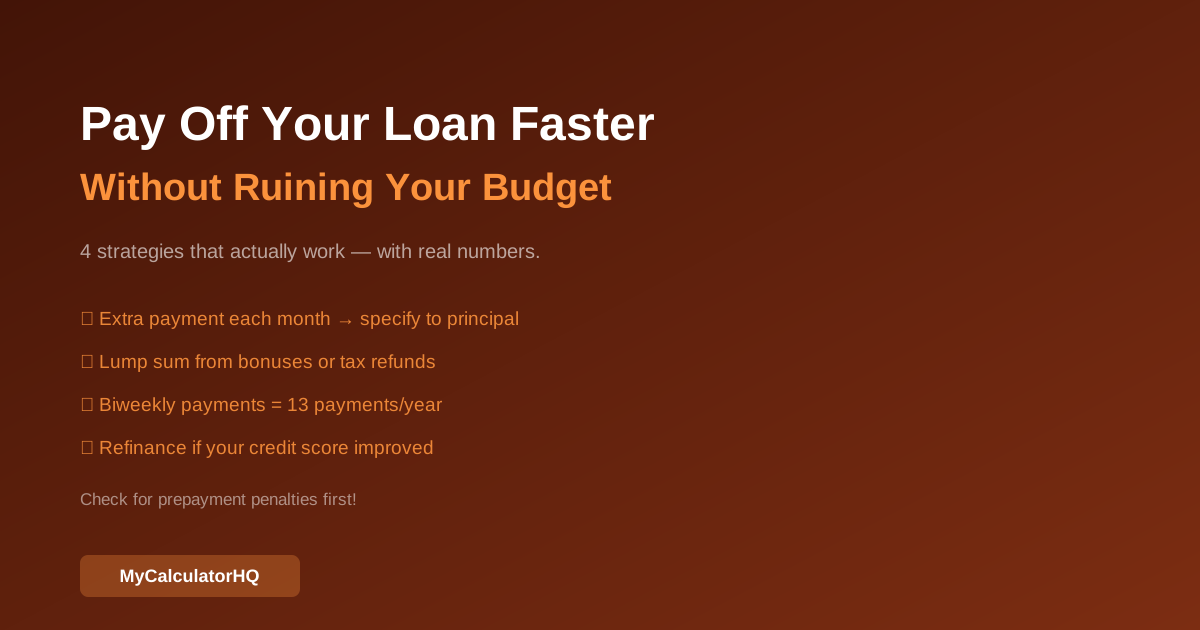
Strategy 1: The Extra-Payment Method
The simplest approach: add a fixed extra amount to each monthly payment.
Even $50 extra per month on a $15,000 loan moves the payoff date noticeably and saves meaningful interest. $100–$200 extra has a significant impact.
The key: make sure the extra amount is specifically applied to principal, not to future payments. When you make a payment online or by phone, there's usually an option to specify. If you pay by check, write "apply to principal" in the memo line.
If you just send extra money without specifying, some lenders will apply it to your next payment — reducing how much you owe next month rather than reducing your balance.
Strategy 2: Lump Sum When You Have It
Tax refund. Work bonus. Gift money. Side hustle income. Any time extra money comes in that wasn't budgeted, apply a chunk (not necessarily all of it) to your loan principal.
A $1,000 lump sum payment on a $15,000 loan at 11% saves roughly $350–$500 in interest depending on where you are in the loan term.
The earlier in the loan you make lump sum payments, the more you save — because there's more time for that reduced principal to generate less interest.
Strategy 3: Biweekly Payments
Instead of one payment per month, pay half your payment every two weeks.
Result: 26 half-payments per year = 13 full payments instead of 12. You make one extra full payment per year without it feeling like a budget adjustment.
Call your lender before trying this — not all lenders accept biweekly payments, and some have specific requirements for how to set it up.
Strategy 4: Refinance to a Lower Rate
If your credit score has improved since you took the loan, you might qualify for a lower interest rate by refinancing.
Refinancing a $12,000 balance from 14% to 8% saves:
- About $80/month in interest
- Roughly $2,880 over a 3-year remaining term
Watch out for origination fees on the new loan — they can eat into your savings. Calculate the break-even point: how long until the interest savings exceed the fees paid.
What Not to Do
Don't deplete your emergency fund. If you drain savings to pay off a loan and then face a car repair or medical bill, you'll likely borrow again — at whatever rate you can get in an emergency, which is rarely good.
Most financial advisors suggest keeping 3–6 months of expenses in an emergency fund before aggressively paying down debt.
Don't neglect higher-interest debt. If you have credit card balances at 20%+ and a personal loan at 10%, pay the credit cards first. The mathematical priority is always the highest-rate debt.
Don't skip retirement contributions for low-rate debt. If your employer matches 401(k) contributions, that match is a 50–100% instant return. It almost always beats paying off a low-rate loan early.
Use our Loan Calculator to see exactly how extra payments affect your payoff date and total interest.
Common Questions
Frequently Asked Questions
Calculators Mentioned in This Article
Related Articles

How to Pay Off Your Mortgage Faster — 5 Strategies That Actually Work

Personal Loan vs. Credit Card: Which One Should You Use?

Fixed vs. Adjustable Rate Mortgage: Which One Is Right for You?
Get calculator tips
Weekly guides. No spam. Free forever.
You're in! Check your inbox.