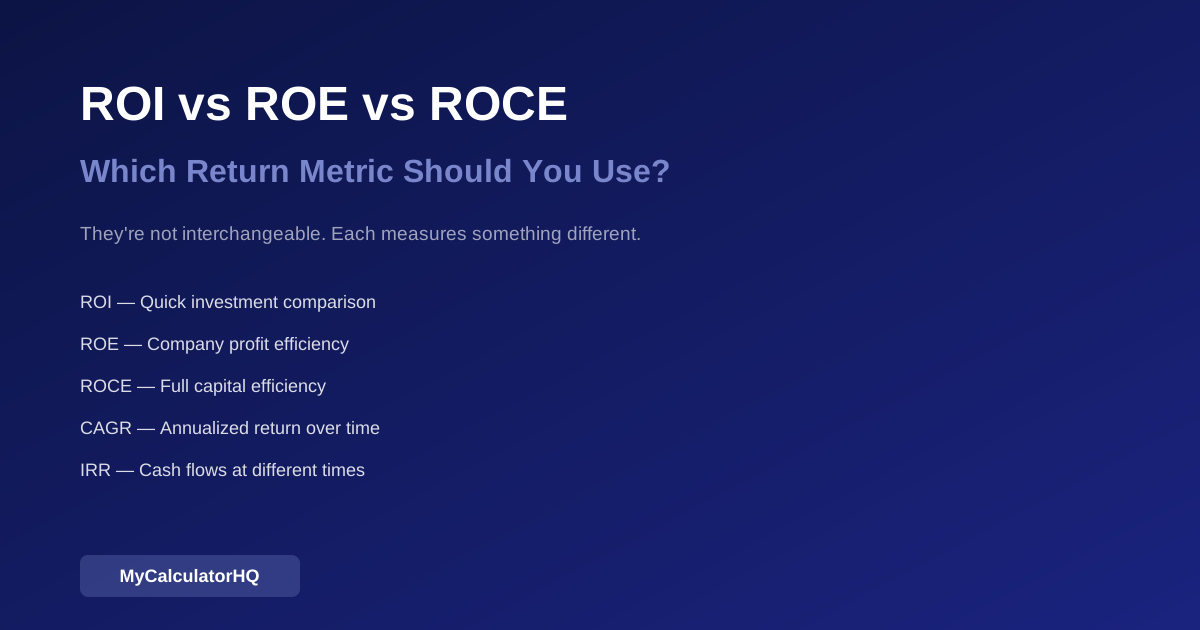
You're evaluating an investment, reading a financial report, or trying to compare two business opportunities. You'll encounter a confusing alphabet soup of return metrics.
They're not interchangeable. Each measures something slightly different. Knowing which one to use in which situation makes a real difference in how you evaluate opportunities.
ROI: Return on Investment
Formula: (Net Profit ÷ Total Investment Cost) × 100
What it measures: The overall return relative to total investment cost.
Best for: Simple, quick comparisons between different investments. Works well for one-time investments with a clear cost and clear return.
Limitation: Doesn't account for time. A 50% ROI over 10 years is very different from 50% over 1 year.
ROE: Return on Equity
Formula: (Net Income ÷ Shareholder Equity) × 100
What it measures: How efficiently a company generates profit from shareholder equity (the money investors have put in).
Best for: Evaluating company performance and comparing companies in the same industry. Warren Buffett looks for companies with ROE consistently above 15%.
Limitation: High debt can artificially inflate ROE because it reduces equity. A company with lots of borrowed money can show high ROE while being financially risky.
Good ROE benchmarks: Under 10% (poor), 10–15% (average), 15–20% (good), 20%+ (excellent)
ROCE: Return on Capital Employed
Formula: EBIT ÷ Capital Employed × 100
(Where EBIT = Earnings Before Interest and Tax, and Capital Employed = Total Assets - Current Liabilities)
What it measures: How efficiently a company uses all its capital — both equity and debt — to generate profit.
Best for: Comparing capital-intensive businesses (manufacturing, utilities, telecoms). Better than ROE for companies with significant debt because it captures the full capital base.
Limitation: More complex to calculate. Requires access to full financial statements.
CAGR: Compound Annual Growth Rate
Formula: ((Ending Value ÷ Beginning Value)^(1/Years)) - 1
What it measures: The annualized return that would produce the same result as the actual (potentially volatile) return over the same period.
Best for: Comparing investments held over different time periods. When someone says "the S&P 500 returned 10% annually," they mean CAGR.
Example: An investment grows from $10,000 to $18,000 over 6 years.
CAGR = (18,000/10,000)^(1/6) - 1 = 1.8^0.167 - 1 = 10.3% per year
IRR: Internal Rate of Return
What it measures: The discount rate that makes the net present value of all cash flows equal to zero. In plain English: the annualized return that accounts for when money comes in and goes out.
Best for: Investments with multiple cash flows over time — real estate (monthly rent), businesses (quarterly profit), bonds (coupon payments). IRR accounts for the timing of those cash flows, which ROI ignores.
Limitation: Requires financial calculator or spreadsheet. Complex to explain to non-financial stakeholders.
Which Should You Use?
| Situation | Best Metric |
|---|---|
| Quick comparison of two investments | ROI |
| Evaluating a public company stock | ROE, ROCE |
| Comparing investments over different time periods | CAGR |
| Real estate or business with ongoing cash flows | IRR |
| Simple yes/no: did this make money? | ROI |
For most personal investment decisions, ROI and CAGR are the most useful starting points. ROE and ROCE become important when you're analyzing stocks. IRR matters most for complex real estate or business decisions.
Start with our ROI Calculator for any investment analysis — the simplest and most versatile return metric.
Common Questions
Frequently Asked Questions
Calculators Mentioned in This Article
Related Articles

How to Pay Off Your Mortgage Faster — 5 Strategies That Actually Work

Personal Loan vs. Credit Card: Which One Should You Use?

Fixed vs. Adjustable Rate Mortgage: Which One Is Right for You?
Get calculator tips
Weekly guides. No spam. Free forever.
You're in! Check your inbox.