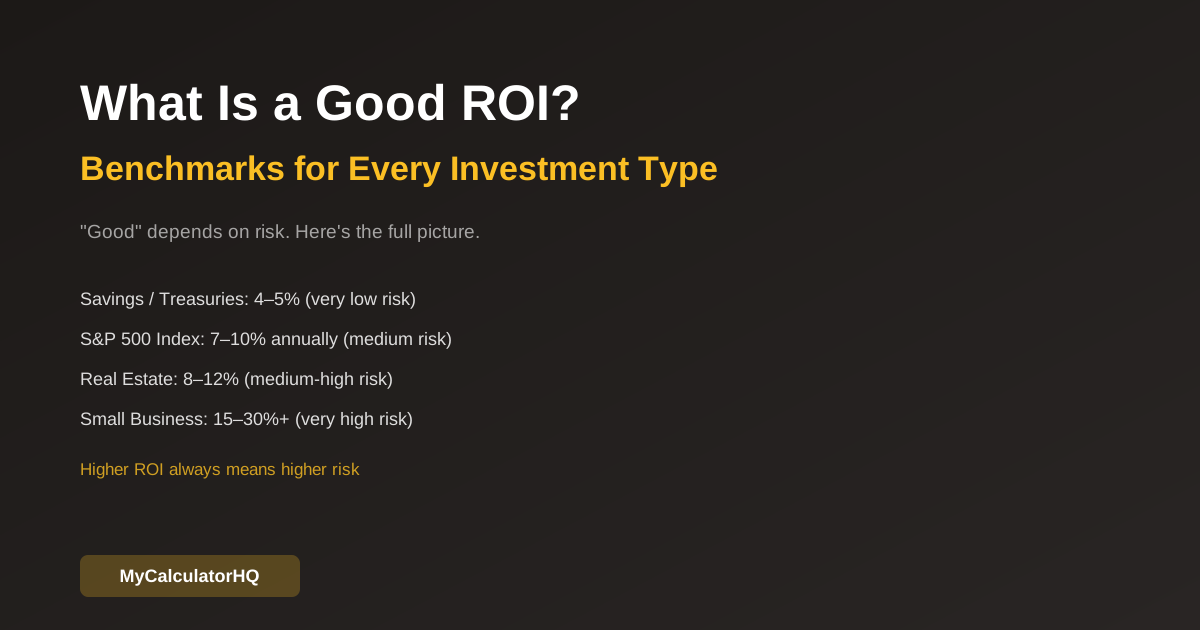
"Is this a good ROI?" is one of the most common questions in investing. The answer is always: compared to what?
A 10% return is exceptional for a savings account, average for stock market investing, and disappointing for a high-risk startup. Context determines whether any ROI number is good, bad, or mediocre.
The Baseline: Risk-Free Rate
Every ROI discussion starts with the risk-free rate — the return you can get with essentially zero risk.
In the US, this is approximated by short-term Treasury bills. As of 2026, that's around 4–5% annually.
Any investment that doesn't beat the risk-free rate significantly needs to justify itself. Why take on risk for a 4% return when Treasuries offer nearly the same with no risk?
Stock Market Benchmarks
The S&P 500 has returned approximately:
- 10–11% annually (nominal) over the past century
- 7–8% annually after inflation
This is the standard benchmark for equity investments. If your stock picks or fund manager consistently underperform the S&P 500 index, you're better off in a simple index fund.
What counts as good for stocks:
- Poor: Under 7% annually (underperforms inflation-adjusted index)
- Average: 7–10% annually
- Good: 10–15% annually
- Exceptional: 15%+ annually (Warren Buffett has averaged ~20% over decades — extremely rare)
Individual year returns vary wildly. The S&P 500 gained 26% in 2023, lost 18% in 2022, gained 29% in 2019. Annualized returns smooth out this volatility.
Real Estate Benchmarks
Real estate returns depend heavily on location, leverage, and management.
National averages (US):
- Home price appreciation: 4–5% annually (historically)
- Rental yield: 5–8% gross annually
- Total return (appreciation + rental income): 8–12% in good markets
What counts as good for rental properties:
- Cash-on-cash return under 4%: Usually not worth the hassle vs. passive investments
- 5–8% cash-on-cash: Acceptable, especially in appreciating markets
- 8–12% cash-on-cash: Good
- 12%+: Excellent — often requires significant value-add work
Business Investment Benchmarks
Business investments carry more risk than passive investments and should therefore demand higher returns.
Small business ROI benchmarks:
- Under 10%: Poor — could do better with passive investing
- 15–25%: Good — justifies the risk and effort
- 30–50%: Very good
- 50%+: Excellent (common in high-margin businesses like software)
Venture capital targets 20–30%+ annual returns across a portfolio, knowing most individual investments will fail but a few will return 10–100x.
The Risk-Return Relationship
Higher potential ROI always comes with higher risk. This relationship is fundamental to investing.
| Investment Type | Typical ROI | Risk Level |
|---|---|---|
| Savings account/CDs | 4–5% | Very low |
| Government bonds | 4–6% | Low |
| Index funds (S&P 500) | 7–10% long-term | Medium |
| Real estate | 8–12% | Medium-high |
| Individual stocks | Highly variable | High |
| Small business | 15–30%+ | Very high |
| Startups/VC | 0% or 10x+ | Extreme |
When to Accept a Lower ROI
Sometimes lower ROI is worth accepting:
- Liquidity: A savings account at 4.5% is more valuable than a rental property at 7% if you might need the money quickly
- Stability: Bonds at 5% might be appropriate if you're near retirement and can't afford volatility
- Tax advantages: A 6% return in a Roth IRA may beat a 9% taxable return after tax
ROI isn't the only variable. Risk, liquidity, taxes, and time horizon all factor into whether a specific investment makes sense for your situation.
Compare any investment's returns with our ROI Calculator.
Common Questions
Frequently Asked Questions
Calculators Mentioned in This Article
Related Articles

How to Pay Off Your Mortgage Faster — 5 Strategies That Actually Work

Personal Loan vs. Credit Card: Which One Should You Use?

Fixed vs. Adjustable Rate Mortgage: Which One Is Right for You?
Get calculator tips
Weekly guides. No spam. Free forever.
You're in! Check your inbox.