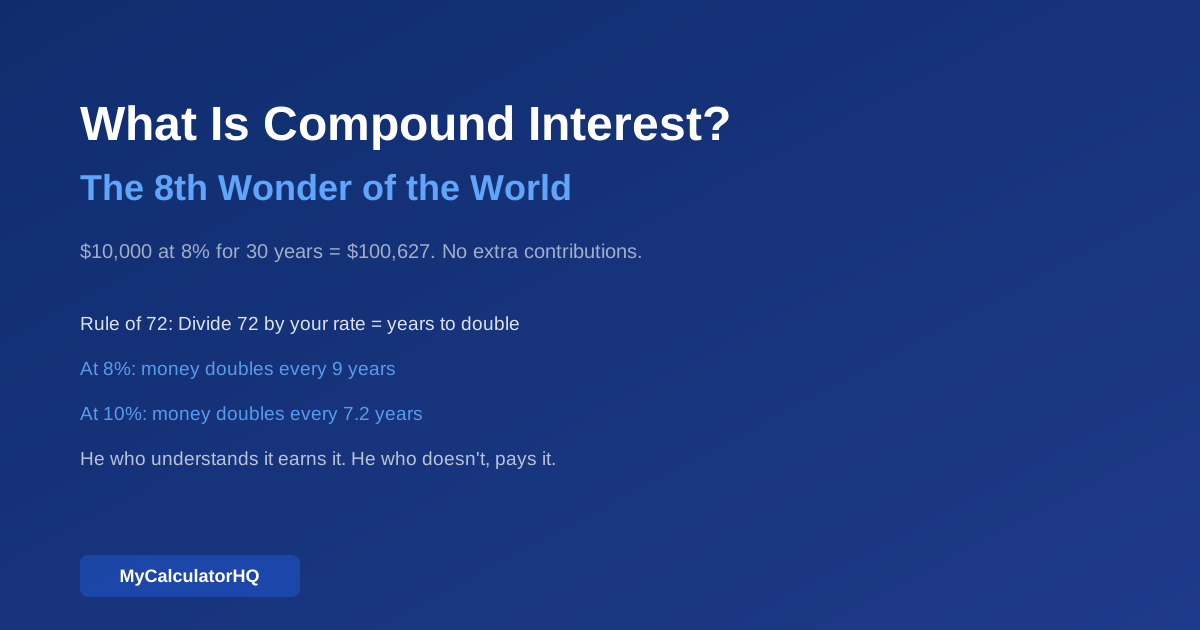
There's a quote — often attributed to Einstein, though probably apocryphal — that calls compound interest the eighth wonder of the world. "He who understands it, earns it. He who doesn't, pays it."
Whether Einstein said it or not, the principle is real. Compound interest is the reason a modest investment made early can grow into life-changing wealth. It's also the reason credit card debt can spiral out of control.
Understanding how it works — really understanding it, not just knowing the word — changes how you think about money.
Simple Interest vs. Compound Interest
Start with the difference.
Simple interest is calculated only on the original principal. If you invest $10,000 at 8% simple interest for 10 years:
Each year you earn $800. After 10 years: $10,000 + ($800 × 10) = $18,000.
Compound interest is calculated on the principal plus all accumulated interest. The same $10,000 at 8% compound interest for 10 years:
- Year 1: $10,000 × 1.08 = $10,800
- Year 2: $10,800 × 1.08 = $11,664
- Year 3: $11,664 × 1.08 = $12,597
- Year 10: $21,589
Simple interest: $18,000. Compound interest: $21,589. The difference is $3,589 — earned purely by earning interest on interest.
Over longer periods, this gap becomes enormous.
The Formula
The compound interest formula is:
A = P(1 + r/n)^(nt)
Where:
- A = final amount
- P = principal (starting amount)
- r = annual interest rate (decimal)
- n = number of times interest compounds per year
- t = time in years
For $10,000 at 8% compounded annually for 30 years:
A = 10,000 × (1.08)^30 = $100,627
Your $10,000 becomes over $100,000. No additional contributions. Just time and compound interest.
How Compounding Frequency Matters
Interest can compound at different frequencies — annually, quarterly, monthly, daily. More frequent compounding means slightly more growth.
$10,000 at 8% for 30 years:
| Compounding Frequency | Final Value |
|---|---|
| Annually | $100,627 |
| Quarterly | $103,640 |
| Monthly | $104,320 |
| Daily | $104,536 |
Daily vs. annual compounding adds about $3,900 over 30 years — meaningful, but not the biggest factor. Time and rate matter far more than compounding frequency.
The Rule of 72
A simple mental shortcut: divide 72 by your interest rate to find approximately how many years it takes to double your money.
- At 6%: 72 ÷ 6 = 12 years to double
- At 8%: 72 ÷ 8 = 9 years to double
- At 10%: 72 ÷ 10 = 7.2 years to double
- At 12%: 72 ÷ 12 = 6 years to double
At 8%, $10,000 doubles to $20,000 in 9 years. Then to $40,000 in 18 years. Then $80,000 in 27 years. Then over $100,000 in 30 years. Each doubling takes the same amount of time — but each doubling adds more absolute dollars than the last.
Why Time Is the Most Important Variable
Consider two investors:
Sarah invests $5,000/year from age 25 to 35 (10 years), then stops. Total invested: $50,000.
Mike invests $5,000/year from age 35 to 65 (30 years). Total invested: $150,000.
At 8% annual return, who has more at age 65?
Sarah: approximately $615,000
Mike: approximately $566,000
Sarah invested for only 10 years and contributed $100,000 less — but she has more money because she started 10 years earlier. Those early years of compounding are irreplaceable.
Compound Interest Working Against You
The same force that builds wealth destroys it when you're the borrower.
A $5,000 credit card balance at 22% annual interest, making only minimum payments:
- Takes approximately 27 years to pay off
- Costs over $6,000 in interest alone
- You pay back more than double what you borrowed
This is compound interest working against you with the same mathematical ruthlessness it uses to build wealth.
The implication: eliminate high-interest debt first. Then let compounding work for you.
See compound interest in action with our Compound Interest Calculator — try different rates, times, and compounding frequencies.
Common Questions
Frequently Asked Questions
Calculators Mentioned in This Article
Related Articles

How to Pay Off Your Mortgage Faster — 5 Strategies That Actually Work

Personal Loan vs. Credit Card: Which One Should You Use?

Fixed vs. Adjustable Rate Mortgage: Which One Is Right for You?
Get calculator tips
Weekly guides. No spam. Free forever.
You're in! Check your inbox.