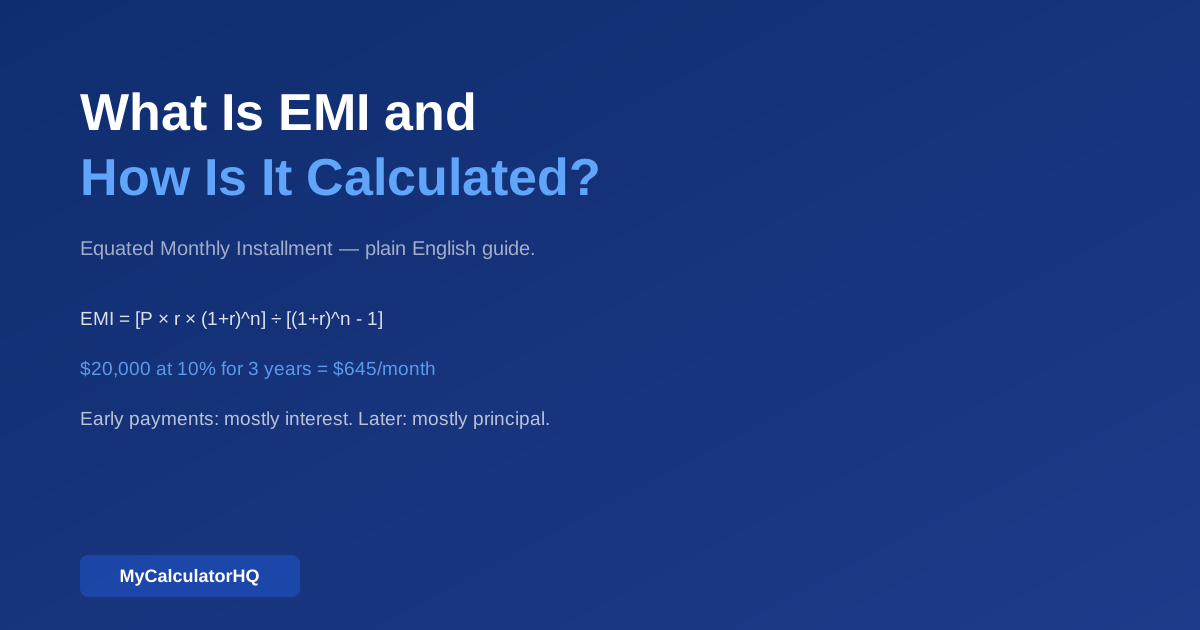
When you take a loan — whether for a home, car, or personal expense — you repay it in fixed monthly amounts called EMIs. Equated Monthly Installments.
The word "equated" is key. Each payment is the same amount every month. But what's inside that payment changes over time — and understanding that breakdown helps you make smarter borrowing decisions.
The EMI Formula
EMI = [P × r × (1+r)^n] ÷ [(1+r)^n - 1]
Where:
- P = Principal loan amount
- r = Monthly interest rate (annual rate ÷ 12)
- n = Number of monthly installments (loan tenure in months)
It looks intimidating. Let's work through a real example.
A Real EMI Calculation
You take a $20,000 personal loan at 10% annual interest for 3 years (36 months).
Monthly interest rate: 10% ÷ 12 = 0.833% = 0.00833
n = 36
EMI = [20,000 × 0.00833 × (1.00833)^36] ÷ [(1.00833)^36 - 1]
(1.00833)^36 = 1.3481
EMI = [20,000 × 0.00833 × 1.3481] ÷ [1.3481 - 1]
EMI = [224.35] ÷ [0.3481]
EMI = $644.88 per month
Total amount paid: $644.88 × 36 = $23,215.68
Total interest paid: $23,215.68 - $20,000 = $3,215.68
How EMI Breaks Down Over Time
Every EMI payment has two parts: interest and principal. The ratio changes every month.
| Month | EMI | Interest | Principal | Balance |
|---|---|---|---|---|
| 1 | $644.88 | $166.67 | $478.21 | $19,521.79 |
| 6 | $644.88 | $144.47 | $500.41 | $16,954.79 |
| 12 | $644.88 | $118.38 | $526.50 | $13,704.50 |
| 24 | $644.88 | $62.91 | $581.97 | $6,965.34 |
| 36 | $644.88 | $5.34 | $639.54 | $0 |
In month 1, $166.67 goes to interest and only $478.21 reduces your debt. By month 36, almost the entire payment goes to principal.
This is amortization — and it's why the early years of any loan feel like you're barely making progress on the balance.
Three Factors That Determine Your EMI
1. Principal (Loan Amount)
The more you borrow, the higher your EMI. This is linear — borrow twice as much, pay roughly twice the EMI.
2. Interest Rate
Even small rate differences have a significant impact over the loan tenure. On a $20,000 loan for 3 years:
- At 8%: EMI = $627
- At 10%: EMI = $645
- At 14%: EMI = $683
- At 18%: EMI = $723
3. Loan Tenure
Longer tenure = lower EMI but much higher total interest. Same $20,000 at 10%:
- 2 years: EMI = $922, Total interest = $2,128
- 3 years: EMI = $645, Total interest = $3,216
- 5 years: EMI = $425, Total interest = $5,496
Extending from 3 to 5 years saves $220/month but costs an extra $2,280 in interest.
Fixed vs. Floating Rate EMI
Fixed rate: Your EMI stays the same throughout the loan. Predictable and safe — especially when rates are low.
Floating rate: Your EMI changes as market interest rates change. Starts lower than fixed rates but carries risk. If rates rise, your EMI rises too.
For short loans (under 3 years), the difference rarely matters much. For long loans like mortgages (15–30 years), the fixed vs. floating decision is significant.
Calculate your exact EMI for any loan with our EMI Calculator — instant results with full amortization breakdown.
Common Questions
Frequently Asked Questions
Calculators Mentioned in This Article
Related Articles

How to Pay Off Your Mortgage Faster — 5 Strategies That Actually Work

Personal Loan vs. Credit Card: Which One Should You Use?

Fixed vs. Adjustable Rate Mortgage: Which One Is Right for You?
Get calculator tips
Weekly guides. No spam. Free forever.
You're in! Check your inbox.