ROI. Return on Investment. You've heard it in business meetings, financial news, and casual conversations about money. It sounds technical but the concept is simple: did you get more back than you put in?
The formula is straightforward. Using it correctly — and avoiding the common mistakes — is where most people stumble.
The Basic ROI Formula
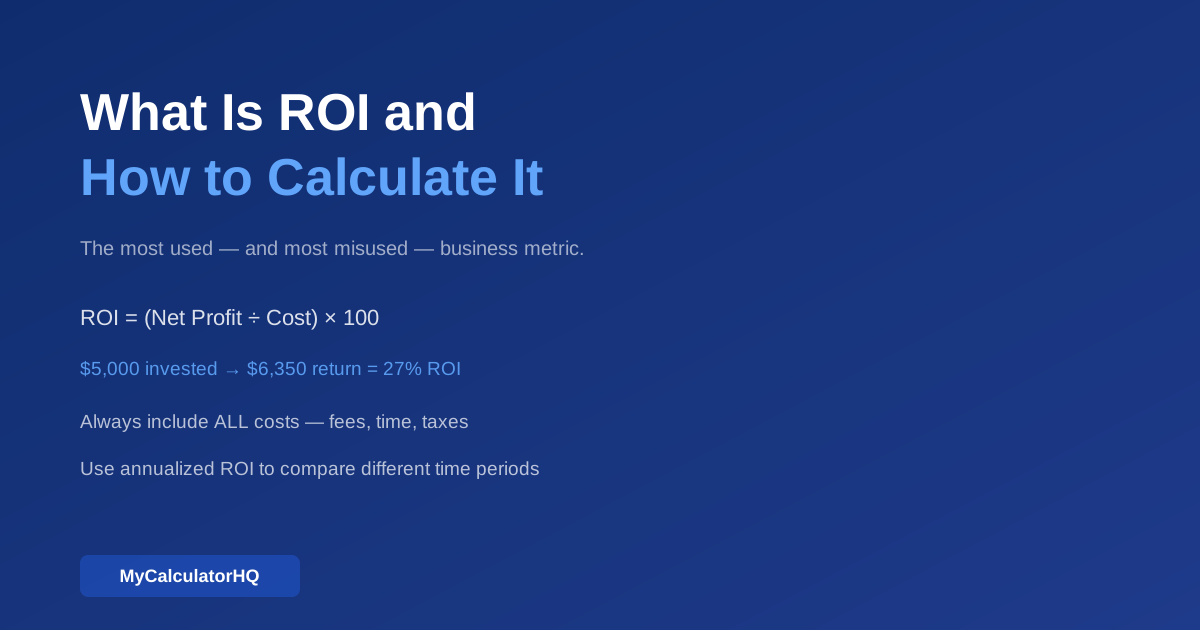
ROI = (Net Profit ÷ Cost of Investment) × 100
Or equivalently:
ROI = ((Return - Cost) ÷ Cost) × 100
The result is expressed as a percentage.
Example 1: Stock investment
You buy $5,000 of stock. One year later, it's worth $6,200. You also received $150 in dividends.
Net profit = ($6,200 - $5,000) + $150 = $1,350
ROI = ($1,350 ÷ $5,000) × 100 = 27%
Example 2: Business investment
You spend $10,000 on a marketing campaign. It generates $28,000 in revenue. Your cost of goods for those sales was $12,000.
Net profit = $28,000 - $12,000 - $10,000 = $6,000
ROI = ($6,000 ÷ $10,000) × 100 = 60%
What Counts as "Cost"?
This is where ROI calculations often go wrong. People undercount costs.
A complete cost calculation should include:
- Direct purchase price or investment amount
- Transaction fees and commissions
- Ongoing maintenance or management costs
- Your time (at its opportunity cost)
- Taxes on gains
That rental property that "made" $15,000 last year — did you account for property management fees, maintenance, vacancy periods, property taxes, insurance, and the time you spent managing it?
Including all costs gives you a realistic ROI. Excluding them gives you a flattering but misleading number.
Annualized ROI: Accounting for Time
Basic ROI doesn't account for how long the investment took. A 50% ROI sounds great — but is it over 2 years or 20 years? Those are very different outcomes.
Annualized ROI formula:
Annualized ROI = ((1 + ROI)^(1/n) - 1) × 100
Where n = number of years
Example: You invested $10,000 and it grew to $18,000 over 5 years.
Total ROI = ($8,000 ÷ $10,000) × 100 = 80%
Annualized ROI = ((1.80)^(1/5) - 1) × 100 = 12.5% per year
The 12.5% annual figure lets you compare this investment to others with different time horizons.
Positive vs. Negative ROI
ROI below 0% means you lost money. ROI of 0% means you broke even. ROI above 0% means you made money.
But "good" ROI depends entirely on context:
- S&P 500 historical average: ~10% annually (7% after inflation)
- Real estate: typically 8–12% annually (highly variable by location)
- High-yield savings account: 4–5% currently
- Successful small business: 15–30%+ (with significant risk)
An investment with 6% ROI might be excellent (if it's risk-free) or disappointing (if the stock market returned 15% that year).
ROI vs. Other Return Metrics
ROI is useful but not the only metric worth knowing:
IRR (Internal Rate of Return): Accounts for the timing of cash flows. Better for evaluating investments with ongoing income or costs at different points in time.
NPV (Net Present Value): Accounts for the time value of money — $1,000 today is worth more than $1,000 in 5 years. Better for long-horizon decisions.
CAGR (Compound Annual Growth Rate): The annualized ROI formula above. Best for comparing investments held over different time periods.
For simple, quick comparisons, ROI works well. For complex investment decisions, these additional metrics add important context.
Calculate any investment's ROI instantly with our ROI Calculator.
Common Questions
Frequently Asked Questions
Calculators Mentioned in This Article
Related Articles

How to Pay Off Your Mortgage Faster — 5 Strategies That Actually Work

Personal Loan vs. Credit Card: Which One Should You Use?

Fixed vs. Adjustable Rate Mortgage: Which One Is Right for You?
Get calculator tips
Weekly guides. No spam. Free forever.
You're in! Check your inbox.